
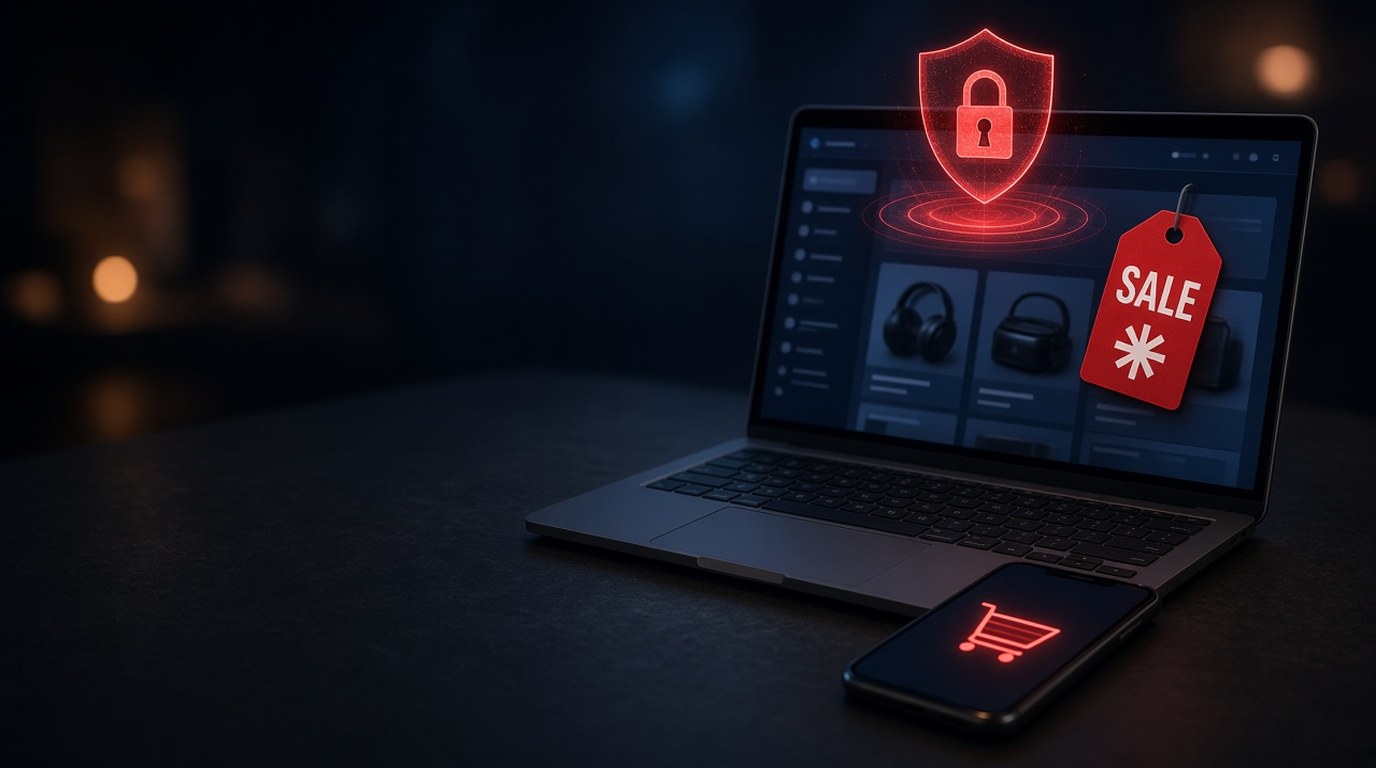
Black Friday falls on November 27, 2026, but the sales have already started. Your inbox is filling up with "limited-time" offers, social media feeds are full of discounted laptops and phones, and every retailer seems to be counting down to something.
Some of these deals are genuinely good. Others only look good because the "original" price was inflated. And a few are not deals at all. They are fake shops, phishing emails, and copycat websites designed to take your money or your card details.
The problem is that all three can look almost identical on your screen.
So how can you tell whether a discount is real? How do you know a website actually belongs to the retailer it claims to be? And what should you do if you have already paid?
In this guide, we'll explore how Black Friday tech scams and misleading discounts work, the warning signs to look for, and a simple checklist you can use before you buy anything this month.
Why Black Friday Is a Busy Season for Scammers
Black Friday is no longer a single day. Many retailers now run sales for weeks, and that gives scammers more time to blend in.
Security company Bitdefender analyzed Black Friday-related spam between October 1 and November 10, 2025. It found that 53% of that spam was scams, while the rest was aggressive marketing. The most impersonated brand was Amazon, which appeared in everything from fake coupon emails to mobile phishing.
Bitdefender also warned that fake delivery and shipping messages tend to spike in the final week of November, when many people are genuinely waiting for packages.
In other words, the period when you are most likely to expect a "your order has been delayed" text is exactly when scammers send the most of them.
Problem 1: Discounts That Are Not Really Discounts
Not every misleading deal is a scam. Sometimes the product is real, the retailer is real, but the discount is much smaller than it looks.
UK consumer group Which? tracked the prices of 175 home, tech, and health products from eight major retailers, including Amazon, Currys, Argos, and John Lewis, for a full year around Black Friday 2024 (May 2024 to May 2025).
The results were clear:
- 83% of products were the same price or cheaper at least once outside the four-week Black Friday sales period.
- 42% of products were cheaper at least once at another time of year.
That does not mean every Black Friday deal is fake. It means a big red "40% off" label tells you very little on its own.
How inflated "was" prices work
A common trick is to raise a product's price a few weeks before the sale, then "cut" it back down on Black Friday.
Which? found one example with a Samsung Jet Bot robot vacuum, advertised by a UK retailer for £350 on Black Friday 2024, down from £500. Earlier that year, the same vacuum had sold for £299 on 29 days in May and June. The £500 price had only been in place since October.
The "discount" was real on paper, but shoppers could have paid less months earlier.
How to check a product's real price history
Before you buy, look at what the product has actually cost over the past few months:
- Amazon: Paste the product link into a price tracker such as Keepa or CamelCamelCamel to see its price history.
- Google Shopping: Compare the same product across retailers. For shoppers in the US, Google can also indicate whether the current price is low, typical, or high.
- Other stores: Write down today's price for the items you want. If the price jumps before the sale and then "drops" back, you will know.
Tip: Compare the exact model number, not just the product name. A "gaming laptop" deal may be last year's model, with less RAM or storage than the version you were reading reviews about.
Problem 2: Fake Shops and Copycat Websites
A fake discount wastes some of your money. A fake shop can take all of it, and your card details too.
Scam websites often copy the logo, product photos, and design of real retailers. They are usually promoted through social media ads, search ads, and emails, and they tend to advertise the products people want most: graphics cards, game consoles, phones, and laptops at prices far below everyone else.
Some send counterfeit goods. Some send nothing at all and stop responding once they have your payment.
Warning signs of a fake shopping website
Be careful if you notice any of the following:
- The price is far below every other major retailer. Big discounts happen, but a brand-new flagship phone at half price from a shop you have never heard of is a serious red flag.
- The web address is slightly wrong. Look for extra words, misspellings, or unusual endings, such as a well-known brand name followed by "-deals" or "-outlet".
- You arrived from an ad or an unexpected message. Scammers rely on you clicking instead of typing the address yourself.
- There is no real contact information. No company name, no physical address, and only a contact form.
- Countdown timers and "only 2 left" pressure. Urgency is designed to stop you from checking.
- The site asks for unusual payment methods. Gift cards, wire transfers, cryptocurrency, or direct bank transfers.
It is also worth remembering that the padlock icon in your browser only means the connection is encrypted. It does not prove that the business behind the website is genuine. Scam sites can have padlocks too.
Marketplaces: check who is actually selling
On large marketplaces, you are often buying from an independent seller rather than the marketplace itself.
On Amazon, for example, check the "Sold by" line and not just "Ships from". A product can ship from Amazon's warehouses while being sold by a completely different company. Read that seller's ratings and reviews before you buy, and always pay through the marketplace's own checkout.
Problem 3: Phishing Emails and Fake Delivery Texts
The third type of Black Friday scam does not try to sell you anything. It tries to get you to log in or "confirm" your details.
Common examples include:
- Fake coupon or gift card emails pretending to come from Amazon or another big retailer.
- "Your package could not be delivered" texts with a link to pay a small redelivery fee.
- "Unusual activity on your account" messages asking you to sign in urgently.
- Ads offering "exclusive Black Friday bonuses" that lead to lookalike login pages or malicious downloads.
Bitdefender reported that one 2025 campaign used fake Facebook ads promoting "Black Friday bonuses" for crypto brands. Victims were sent to lookalike pages that delivered information-stealing malware designed to harvest browser data, passwords, and crypto-wallet information.
The safest habit is simple: do not use the link in the message. Open the retailer's app, or type the website address yourself, and check your orders or account there.
Turning on stronger sign-in protection also helps. If a retailer or email provider supports passkeys or two-step verification, now is a good time to enable them. We covered how passkeys work in our article on why a future without passwords is closer than you think.
A Quick Checklist Before You Buy Any Tech Deal
Use this checklist for anything expensive you are about to buy this month:
- Go to the retailer directly. Type the address or use the official app instead of clicking an ad or email link.
- Check the full web address before you enter any personal or payment information.
- Look up the price history with a tracker or price comparison tool.
- Confirm the exact model, storage, RAM, and whether it is new, refurbished, or open-box.
- Check who the seller is on marketplaces, and read recent reviews from independent sources.
- Read the returns policy and warranty terms before checking out.
- Calculate the final price, including shipping, fees, and any conditions attached to a coupon.
- Pay with a credit card where possible. The US Federal Trade Commission (FTC) recommends credit cards because they make it easier to dispute charges for items that never arrive.
- Walk away if a seller insists on gift cards, wire transfers, payment apps, or cryptocurrency.
- Keep records: screenshots of the listing, your order confirmation, and any messages with the seller.
If you are buying a used or refurbished laptop, ask the seller for a battery report before you pay. Our guide on how to check laptop battery health in Windows 11 without extra software explains how to read one in a few minutes.
Is It Worth Waiting for Black Friday at All?
Sometimes, yes. Black Friday can bring genuine discounts, especially on products that have been out for a while.
But the Which? research suggests that waiting is rarely essential. In its study, many products were available at the same price or lower at other times of the year, including after the sales ended.
A good approach is to decide what you need before the sales start. Set a maximum price based on the price history, and only buy if a deal beats it.
If you are considering a brand-new device, such as one of the new MacBook Pro models for 2026, be especially cautious of unusually large discounts on newly launched products from unfamiliar sellers. Genuine discounts on brand-new flagship hardware are usually modest.
What to Do If You Think You Have Been Scammed
If you have paid a website or seller you no longer trust, act quickly:
- Contact your bank or card provider immediately. Ask them to block the card if needed and to dispute the payment.
- Change your passwords for any account you signed in to through a suspicious link, starting with your email account. Turn on two-step verification.
- Report the ad or listing to the platform where you found it.
- Report the scam to your national fraud authority. In the US, you can report it to the FTC at ReportFraud.ftc.gov.
- Keep evidence: screenshots, order numbers, emails, and payment details.
The sooner you contact your bank, the better your chances of stopping or reversing the payment.
Frequently Asked Questions
When is Black Friday 2026?
Black Friday 2026 is on Friday, November 27. Many retailers start their sales weeks earlier, and Cyber Monday follows on November 30.
Are Black Friday tech deals real?
Some are, but many are not as good as they look. Which? found that 83% of the products it tracked were the same price or cheaper at least once outside the Black Friday sales period. Always check the price history.
How can I tell if a shopping website is fake?
Check the full web address, look for real contact details, compare prices with major retailers, and be wary of pressure tactics and unusual payment requests. A padlock icon alone does not prove a site is legitimate.
What is the safest way to pay online during Black Friday?
A credit card generally offers the strongest protection if an item never arrives, because you can dispute the charge. Avoid paying by gift card, wire transfer, bank transfer, or cryptocurrency to sellers you do not know.
Should I click links in Black Friday emails?
It is safer not to. Open the retailer's app or type its web address yourself to find the same offer. If the deal is real, it will be there.
Final Thoughts
Black Friday tech scams work because they look like the real thing and arrive at a time when everyone expects deals, discounts, and delivery updates.
The good news is that a few habits protect you from most of them: go to the retailer directly, check the price history, confirm who the seller is, and pay with a method that lets you dispute the charge.
A genuine deal will still be there after you take two minutes to check it.
The best Black Friday deal is the one you actually needed, at a price you verified, from a seller you trust.
Sources and Further Reading
- Which? — Most Black Friday deals the same price or cheaper at other times of the year
- Which? — Black Friday 2026 dates and deals
- Bitdefender — Black Friday 2025 scams: brand impersonation, old scams, and familiar malware
- Engadget — How to spot fake Black Friday tech deals
- FTC — Report fraud
Information in this article reflects sources available on November 15, 2026. Retailer policies, prices, and payment protections vary by country and may change.

The conversation (0)
Different perspectives make better conversations. Keep it thoughtful.
Be the first to share a perspective.