
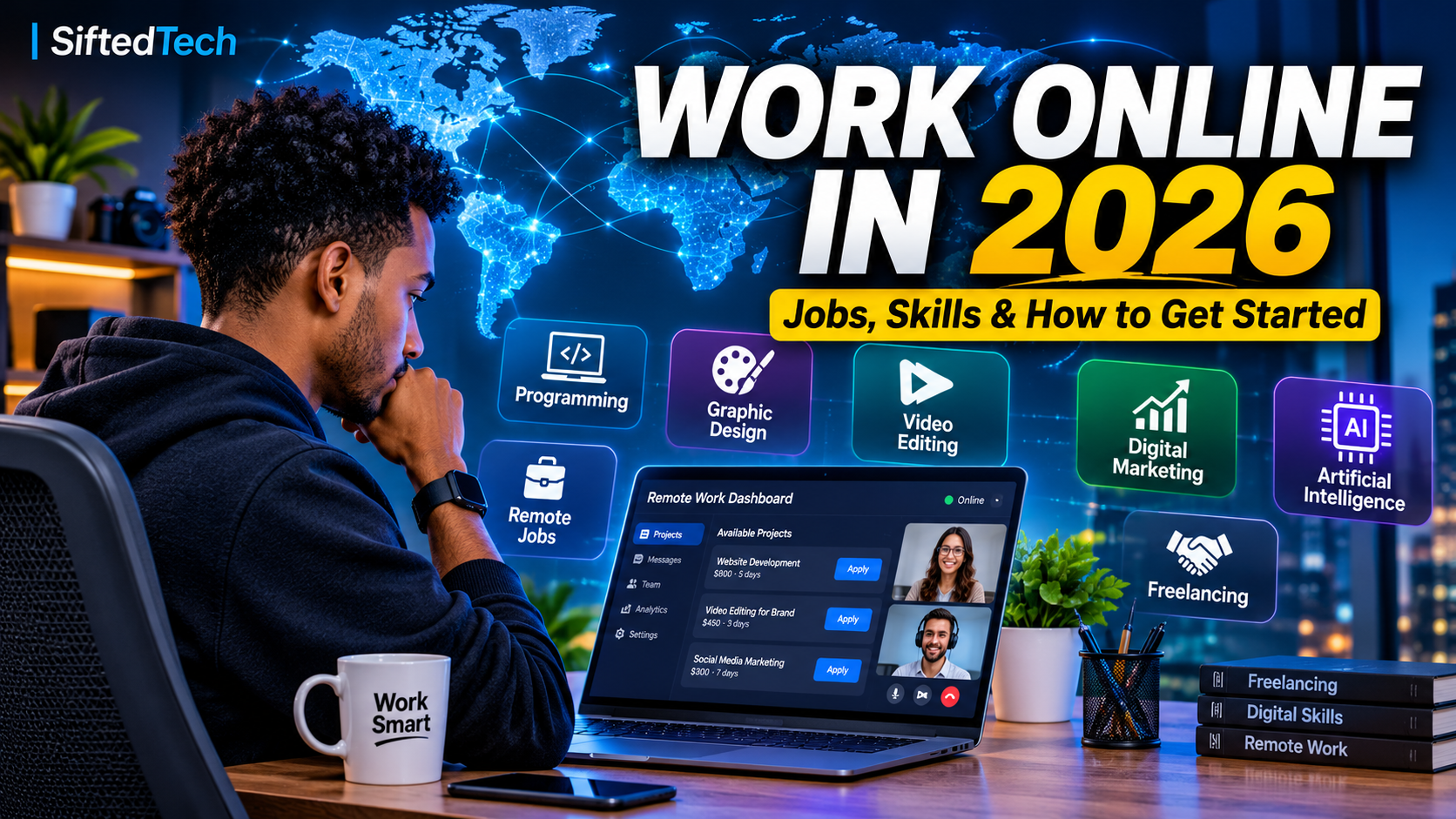
How to Start Working Online in 2026: Best Online Jobs, Freelancing Platforms, and Skills You Need
Imagine waking up, opening your laptop, and starting your workday without travelling to an office. Your clients could be in another country, your team could be distributed across different time zones, and your workplace could be almost anywhere with a reliable internet connection.
This is no longer just an idea of the future. Millions of people around the world are using the internet to find jobs, offer professional services, build businesses, and earn money.
Working online has created new opportunities for students, graduates, professionals, entrepreneurs, and people looking for additional income.
But getting started is not always easy.
Some people do not know which online jobs are legitimate. Others struggle to identify the right skills, find their first clients, or choose a trustworthy platform.
So, how can you start working online in 2026? Which jobs offer real opportunities? And what do you need to succeed?
In this guide, we explore the world of online work, the most popular opportunities, useful platforms, essential digital skills, and practical steps to help you begin.
[COVER IMAGE — THE WORLD OF ONLINE WORK]
What Is Online Work?
Online work refers to any professional activity that can be performed using the internet instead of requiring someone to work physically in a traditional workplace.
It allows individuals and businesses to communicate, collaborate, exchange services, and complete projects through digital platforms.
Unlike traditional employment, some online jobs offer greater flexibility regarding working hours and location. However, this depends on the employer, contract, and type of work.
Online work generally falls into several categories:
-
Remote employment: Working for a company from a location outside its physical office.
-
Freelancing: Offering professional services to different clients on a project or contract basis.
-
Online business: Selling products or services through the internet.
-
Content creation: Producing videos, articles, podcasts, and other digital content.
-
Digital entrepreneurship: Building online services, applications, websites, or digital products.
These opportunities are changing how people think about employment and professional careers.
Why Is Online Work Becoming So Popular?
The growth of digital technology has changed the way businesses operate.
Companies can now communicate with employees across continents, manage projects remotely, and hire professionals based on their skills rather than their physical location.
There are several reasons why online work continues to attract attention.
1. Work From Almost Anywhere
One of the biggest advantages of online work is location flexibility.
Depending on the job, you may be able to work from your home, a shared workspace, or another location with an internet connection.
This can reduce commuting time and make employment opportunities accessible to people who live far from major business centres.
2. Access to International Opportunities
The internet connects professionals with businesses and clients around the world.
A graphic designer can work with a company in Europe, a web developer can build a website for an American business, and a video editor can produce content for a client in another country.
Your potential market is no longer limited to your local area.
3. Flexible Working Arrangements
Freelancers often have more control over which projects they accept and how they organize their schedules.
Some remote employees also enjoy flexible working arrangements, although many companies still require fixed working hours and regular meetings.
4. Opportunities to Learn New Skills
Online work encourages continuous learning.
People can develop professional skills through online courses, tutorials, practical projects, and collaboration with experienced professionals.
The World Economic Forum's Future of Jobs Report 2025 identifies AI and big data, cybersecurity, and technological literacy among the fastest-growing skill areas expected through 2030.
5. Different Ways to Earn Income
Online work is not limited to one profession.
People can earn money by developing websites, editing videos, writing articles, managing social media accounts, providing virtual assistance, teaching, or selling digital products.
The important thing is finding a service or skill that people are willing to pay for.
[IMAGE 1 — THE GLOBAL DIGITAL WORKFORCE]
Suggested image: A professional working on a laptop in a modern home office, with subtle visual connections representing international communication and digital collaboration.
The Best Online Jobs You Can Start in 2026
One of the most important steps when entering the online job market is choosing the right type of work.
You do not need to learn everything. Different opportunities require different levels of experience, equipment, and technical knowledge.
Here are some popular online career options.
1. Freelance Writing and Content Creation
Writing is one of the services businesses need for their online presence.
Freelance writers create blog articles, website content, product descriptions, advertising copy, newsletters, and social media posts.
If you enjoy writing and communicating ideas, this could be a good starting point.
Popular services include:
-
Blog and article writing.
-
Website content writing.
-
Copywriting.
-
Product descriptions.
-
Technical writing.
-
Proofreading and editing.
Writers can build portfolios by creating sample articles and publishing their work online.
2. Graphic Design
Graphic design is another popular online service.
Businesses need attractive visual content to promote products, communicate with customers, and build recognizable brands.
Graphic designers can work on:
-
Logo design.
-
Business cards.
-
Social media graphics.
-
Advertising banners.
-
Website graphics.
-
Marketing materials.
Popular tools include Adobe Photoshop, Illustrator, Canva, and Figma.
A strong portfolio is often more useful than simply listing software skills.
3. Video Editing
Online video content has become an important part of digital communication and marketing.
Businesses, influencers, YouTubers, and content creators regularly need editors to turn raw footage into professional videos.
Video editing opportunities include:
-
YouTube video editing.
-
TikTok and Instagram Reels editing.
-
Wedding video editing.
-
Promotional videos.
-
Corporate videos.
-
Short-form advertising content.
Popular editing software includes Adobe Premiere Pro, DaVinci Resolve, and Final Cut Pro.
This field can be particularly attractive to people who enjoy storytelling and visual creativity.
4. Web Development and Programming
Web development is one of the most technical online career paths.
Developers build and maintain websites, web applications, online stores, and other digital products.
Some common services include:
-
Front-end development.
-
Back-end development.
-
Full-stack development.
-
WordPress development.
-
E-commerce website development.
-
Website maintenance.
-
API development.
Popular technologies include HTML, CSS, JavaScript, React, Python, PHP, and Node.js.
Developers can demonstrate their abilities through personal projects, GitHub repositories, and live websites.
5. Digital Marketing
Businesses need customers, and digital marketing helps them reach those customers through online channels.
Digital marketers help organizations promote their products and services using different digital strategies.
Popular services include:
-
Search Engine Optimization (SEO).
-
Social media marketing.
-
Email marketing.
-
Content marketing.
-
Search advertising.
-
Social media management.
-
Marketing analytics.
Digital marketing is a broad field, so beginners should consider learning one area before offering several services.
6. Virtual Assistant
Virtual assistants provide administrative and organizational support remotely.
Their responsibilities depend on the client, but common tasks include:
-
Managing emails.
-
Scheduling appointments.
-
Organizing documents.
-
Researching information.
-
Updating spreadsheets.
-
Managing calendars.
-
Supporting customer communication.
This can be an entry point for people with strong organizational and communication skills.
7. Online Teaching and Tutoring
People with knowledge of a particular subject can offer educational services through the internet.
Online tutors may teach languages, mathematics, programming, science, business, or other subjects.
Teaching opportunities can include one-to-one lessons, group classes, recorded courses, and educational content.
A good internet connection, communication skills, and knowledge of the subject are important.
8. Data Analysis
Organizations collect large amounts of information and need professionals who can understand and interpret it.
Data analysts organize information, identify patterns, prepare reports, and help businesses make better decisions.
Useful tools include:
-
Microsoft Excel.
-
SQL.
-
Python.
-
Power BI.
-
Tableau.
This field requires analytical thinking and practical experience with data.
[IMAGE 2 — DIFFERENT TYPES OF ONLINE JOBS]
Suggested image: A professional editorial collage showing a graphic designer, web developer, video editor, writer, and digital marketer working on computers in different modern workspaces.
Best Websites to Find Online Work
Finding legitimate opportunities is one of the biggest challenges for beginners.
Fortunately, several established platforms connect businesses with freelancers and remote professionals.
Here are some platforms worth exploring.
1. Upwork
Website: https://www.upwork.com/
Upwork is a freelance marketplace where clients publish projects and professionals submit proposals.
You can find opportunities in areas such as:
-
Programming.
-
Design.
-
Writing.
-
Marketing.
-
Video editing.
-
Customer support.
-
Data analysis.
To get started, create a professional profile, describe your services, add examples of your work, and apply for projects that match your skills.
Upwork has platform fees and proposal requirements, so review its current pricing and policies before applying.
2. Fiverr
Website: https://www.fiverr.com/
Fiverr allows freelancers to advertise specific services through listings known as Gigs.
For example, a graphic designer could offer logo design, while a video editor could offer YouTube editing or short-form video production.
Customers can browse these services and place orders.
To improve your chances of attracting clients, create clear service descriptions, professional images, competitive packages, and examples of your previous work.
3. Freelancer.com
Website: https://www.freelancer.com/
Freelancer.com is another marketplace that connects clients with professionals.
Clients publish projects, and freelancers can submit bids to compete for the available work.
The platform covers programming, writing, design, marketing, engineering, and many other categories.
4. LinkedIn
Website: https://www.linkedin.com/
LinkedIn is a professional networking platform that can help people discover remote employment and connect with companies.
You can:
-
Build a professional profile.
-
Display your experience and skills.
-
Search for remote job vacancies.
-
Connect with recruiters.
-
Follow companies.
-
Share your professional projects.
It is particularly useful for people interested in long-term remote employment rather than only short freelance projects.
5. Indeed
Website: https://www.indeed.com/
Indeed is a job-search platform where you can find employment opportunities across different industries.
Use search terms such as:
-
Remote developer.
-
Remote graphic designer.
-
Online customer support.
-
Remote digital marketing specialist.
-
Virtual assistant.
Always read the job description carefully and verify the employer before sharing personal information.
6. PeoplePerHour
Website: https://www.peopleperhour.com/
PeoplePerHour connects freelancers with businesses looking for professional services.
Its categories include design, technology, writing, marketing, and business support.
Freelancers can create profiles and explore available projects.
Important: Platform registration, payment options, fees, and country eligibility can change. Before investing time in an account, confirm that the service accepts workers in your country and supports a payment method you can actually use.
[IMAGE 3 — POPULAR FREELANCING PLATFORMS]
Suggested image: A clean professional technology illustration featuring a laptop displaying freelance project listings, a freelancer profile, and digital collaboration tools. Avoid misleading platform logos.
What Skills Do You Need to Work Online?
Having internet access is not enough to build a successful online career.
You need skills that solve real problems for businesses or individuals.
Some jobs require technical expertise, while others depend more on communication, organization, creativity, and reliability.
Here are some important skills to develop.
Technical Skills
Depending on your career direction, useful technical skills include:
-
Programming and web development.
-
Graphic design.
-
Video editing.
-
SEO.
-
Data analysis.
-
Digital advertising.
-
Website management.
Communication Skills
Online workers frequently communicate with clients and colleagues through email, messaging applications, video meetings, and project management platforms.
Clear communication helps prevent misunderstandings and builds professional relationships.
Time Management
Working remotely requires discipline.
You may need to manage multiple deadlines, organize projects, and complete tasks without someone physically supervising your work.
Problem-Solving
Clients hire professionals because they need solutions.
Being able to understand a problem, research possible approaches, and deliver a useful result can make you more valuable.
Continuous Learning
Technology changes quickly.
New software, tools, and working methods continue to influence the digital job market.
Developing a habit of learning can help you remain competitive.
[IMAGE 4 — DIGITAL SKILLS FOR THE FUTURE]
Suggested image: A modern technology-themed visual showing programming, artificial intelligence, cybersecurity, creative design, and data analysis as connected digital skills.
How to Start Working Online With No Experience
Starting without professional experience can feel difficult, but you do not need to master everything before beginning.
A practical approach is to learn one skill, build examples, and gradually start looking for clients.
Here is a step-by-step approach.
Step 1: Choose One Skill
Start by identifying something you enjoy or already understand.
For example:
-
Interested in creativity? Start with graphic design or video editing.
-
Interested in technology? Explore web development or programming.
-
Good at communication? Consider writing or virtual assistance.
-
Interested in business? Learn digital marketing or SEO.
Avoid trying to learn five different professions at the same time.
Step 2: Learn the Basics
Use online educational resources to develop your knowledge.
YouTube, freeCodeCamp, Coursera, and other educational websites offer learning materials for different professional skills.
Focus on practical learning rather than only watching tutorials.
Step 3: Build a Portfolio
A portfolio is a collection of examples that demonstrates what you can do.
If you want to become a video editor, create several sample videos.
If you want to become a web developer, build a few websites.
If you want to become a graphic designer, create logos, posters, and social media designs.
You can create sample projects even before finding your first paying client.
Step 4: Create a Professional Profile
Choose a suitable platform and create a profile that explains:
-
Who you are.
-
What services you provide.
-
Which tools you use.
-
What problems you can solve.
-
Examples of your work.
Make your profile specific rather than claiming to do everything.
Step 5: Start Applying for Opportunities
Search for projects that match your current abilities.
Write personalized applications explaining how you can help the client.
Avoid sending the same generic message to every job posting.
Step 6: Deliver Quality Work
Once you find your first client, focus on understanding the requirements and meeting the agreed deadline.
Professional communication and reliable delivery can help you build a good reputation.
Step 7: Improve and Grow
After completing projects, review your work, improve your skills, and update your portfolio.
Over time, you can specialize in a particular service, increase your rates, and develop long-term client relationships.
Can You Work Online From Anywhere in the World?
One of the most exciting aspects of online work is the ability to connect with international businesses.
However, working online from another country involves more than simply having an internet connection.
There are several things to consider.
Internet Access
A stable internet connection is important for communication, uploading files, attending meetings, and completing projects.
Equipment
Some online jobs require only a smartphone, while others need a laptop or desktop computer.
For example, programming, professional video editing, and data analysis generally require more capable hardware.
International Payments
Getting paid is an important part of working with international clients.
Different platforms support different payment methods, which may include bank transfers and third-party payment services.
Before accepting work, confirm how you will receive the money, what fees apply, and whether the payment method is available in your country.
Time Zones
International clients may operate in different time zones.
You should agree on deadlines, communication hours, and meeting schedules before beginning a project.
Local Requirements
Depending on your location and the nature of your work, you may need to consider local tax, business registration, and other legal requirements.
Online Work Opportunities in Ethiopia
Online work can also create opportunities for people living in Ethiopia.
With suitable skills, internet access, and a reliable way to receive payments, professionals can explore both local and international digital work.
Some practical opportunities include:
-
Website development for local and international businesses.
-
Graphic design for companies and content creators.
-
Video editing for YouTube and social media.
-
Digital marketing for local businesses.
-
Translation and writing services.
-
Online tutoring.
-
Virtual assistance.
-
Data analysis.
There are also opportunities to provide digital services to Ethiopian businesses that want to improve their online presence.
However, international platforms do not necessarily support every country, and payment services have different availability requirements.
Before registering, check the platform's current country eligibility and withdrawal options.
The most important thing is to develop a service that has real value rather than depending on websites that promise quick and guaranteed income.
The Role of Artificial Intelligence in Online Work
Artificial intelligence is changing the way people work online.
AI-powered tools can help professionals complete certain tasks faster, generate ideas, organize information, and improve productivity.
For example:
-
Writers can use AI tools to brainstorm article ideas.
-
Designers can explore creative concepts.
-
Developers can use coding assistants.
-
Video editors can automate certain editing tasks.
-
Marketers can analyze information and develop content strategies.
-
Virtual assistants can automate repetitive administrative tasks.
However, AI does not remove the need for professional knowledge.
People still need to check accuracy, understand client requirements, make decisions, and deliver high-quality results.
The strongest approach is to combine professional skills with responsible use of AI tools.
[IMAGE 5 — AI AND THE FUTURE OF ONLINE WORK]
Suggested image: A professional working with an AI-powered computer interface, surrounded by subtle visual elements representing automation, creativity, coding, and digital collaboration.
How Much Money Can You Earn From Online Work?
There is no single answer because online income depends on several factors.
Your earnings may depend on:
-
The type of service you provide.
-
Your experience and skill level.
-
The complexity of the project.
-
Your clients and target market.
-
The time you invest.
-
Competition and demand.
-
Platform fees and other business expenses.
For example, a beginner offering simple graphic design services may earn differently from an experienced software developer building a complex application.
Freelancers may charge per project, per hour, or through longer-term contracts.
Remote employees may receive fixed salaries depending on their employer and employment agreement.
Content creators and online business owners may have less predictable income, particularly when they are starting.
It is important to understand that online work is not a guaranteed way to become rich quickly.
Building a reliable income usually requires skills, consistency, patience, and professional relationships.
How to Avoid Online Job Scams
As online work becomes more popular, fraudulent job offers have also become a serious concern.
Some websites and individuals advertise unrealistic earning opportunities to attract people who are searching for employment.
The Federal Trade Commission warns about task scams in which people receive unexpected online job offers and are eventually asked to deposit their own money to unlock supposed earnings.
Here are some important warning signs.
1. Guaranteed High Earnings
Be careful when someone promises unusually high income for very little work.
Legitimate employers and clients generally explain the responsibilities and payment arrangements.
2. Paying Money to Get a Job
Be suspicious if someone asks you to deposit money to unlock tasks, receive commissions, or access your salary.
Never send money simply because someone promises you an online job.
3. Unrealistic Job Offers
Messages promising large amounts of money for simple likes, ratings, or clicks may be fraudulent.
Research the company before accepting an offer.
4. Requests for Sensitive Information
Do not share passwords, verification codes, or unnecessary financial information with unknown individuals.
5. Moving Away From Protected Payment Systems
When using a freelance marketplace, understand its payment and communication policies.
Keeping eligible contracts and payments within the platform can help protect you.
Remember: A genuine online career is built through useful skills and professional work, not through suspicious earning schemes.
What Is the Future of Online Work?
The future of online work will continue to be influenced by digital technology, artificial intelligence, global business, and changing professional skills.
Companies are increasingly using digital tools to connect teams, automate tasks, and access specialized expertise.
At the same time, professionals need to adapt as technology changes the requirements of different occupations.
Some important developments include:
Artificial Intelligence: AI tools will continue to influence how people write, design, program, analyze information, and manage businesses.
Remote Collaboration: Digital communication and project management tools will remain important for distributed teams.
Specialized Freelancing: Businesses may continue to seek independent professionals with specific technical and creative abilities.
Digital Entrepreneurship: More individuals can use online platforms to build businesses, sell digital products, and reach international customers.
Continuous Learning: Professionals will need to update their skills as industries and technologies evolve.
The future is not simply about working from a computer. It is about using technology to create value, solve problems, and connect with opportunities around the world.
Frequently Asked Questions
1. Can I start working online without experience?
Yes. You can begin by learning a practical skill, creating sample projects, and building a portfolio. Some opportunities are suitable for beginners, but you should expect competition and a learning period.
2. Which online job is best for beginners?
There is no single best option. Writing, graphic design, video editing, virtual assistance, and basic digital services can be good starting points depending on your interests and abilities.
3. Can I work online using only a smartphone?
Yes, some tasks can be completed using a smartphone, including basic social media management, communication, and simple content creation. However, many professional jobs are easier with a computer.
4. Do I need money to start working online?
Not necessarily. You can learn many skills and create sample projects using free resources. However, internet access, equipment, software, and some platform services may involve costs.
5. Which websites are best for finding online jobs?
Upwork, Fiverr, Freelancer.com, LinkedIn, Indeed, and PeoplePerHour are examples of platforms where people can explore freelance or remote opportunities. Availability and eligibility vary.
6. Can I earn money online from Ethiopia?
There are opportunities to provide digital services to local and international clients. However, you should check platform eligibility, payment options, and local requirements before starting.
7. How long does it take to earn your first money online?
It depends on your skills, portfolio, competition, and ability to find clients. Some people find opportunities quickly, while others need weeks or months of preparation and applications.
8. Is online work a real career?
Yes. Remote employment, freelancing, software development, digital marketing, online education, and other digital professions can become long-term careers.
9. Is freelancing better than a traditional job?
Both have advantages and disadvantages. Freelancing can offer flexibility and independence, while traditional employment may provide more predictable income and benefits. The right choice depends on your goals and circumstances.
10. Can artificial intelligence help me work online?
Yes. AI can support research, writing, programming, design, and productivity. However, professional judgment and the ability to deliver useful results remain important.
Conclusion: Is Online Work Worth Starting in 2026?
The internet has created a world where professional opportunities are no longer limited to traditional offices or local businesses.
People can now develop skills, work with international clients, build digital businesses, and explore different career paths from almost anywhere.
However, success does not happen simply by creating an account on a freelancing website.
It starts with learning something valuable, practising consistently, building a portfolio, and finding people who need your services.
Whether you choose web development, graphic design, video editing, digital marketing, writing, or another profession, the most important step is to begin with a clear direction.
You do not need to know everything today. Choose one skill, improve it, and take your first step.
The internet provides access to opportunities, but your knowledge, creativity, discipline, and commitment will determine how you use them.
Your next career opportunity might not be waiting in an office. It might be waiting online.
Further Reading
-
Upwork — How to Use Upwork as a Freelancer.
-
World Economic Forum — Future of Jobs Report 2025.
-
Federal Trade Commission — How to Spot and Avoid Task Scams.
-
Coursera — Freelancer Jobs and How to Get Started.
-
Hostinger — Legitimate Ways to Make Money Online.


The conversation (0)
Different perspectives make better conversations. Keep it thoughtful.
Be the first to share a perspective.